 Site
4 Ways to Improve Your WordPress Maintenance Sales Conversion
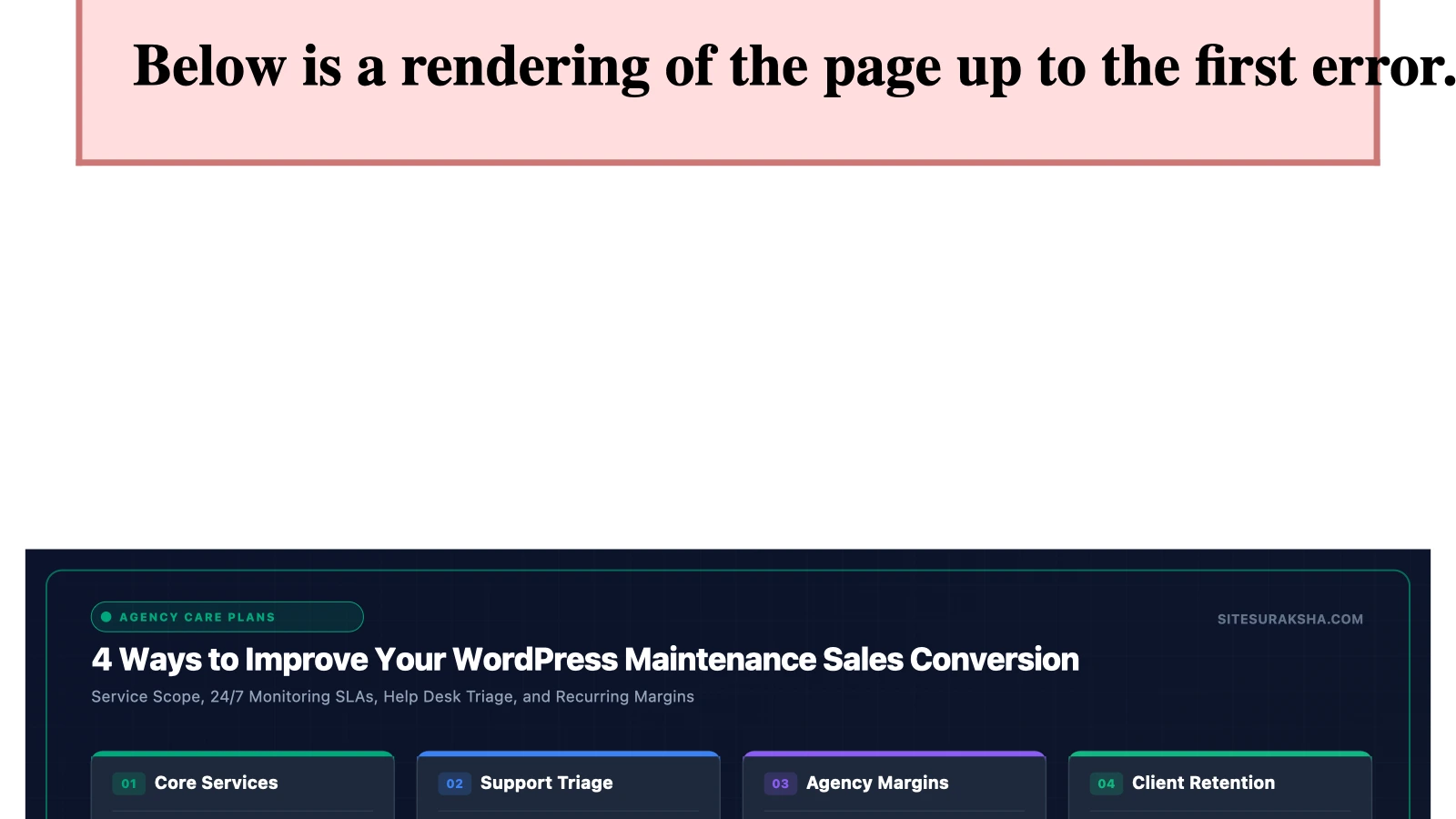
Selling WordPress maintenance contracts often presents a persistent business challenge for agencies and independent developers. Website owners frequently view ongoing maintenance as an arbitrary recurring tax rather than an essential operational safeguard, particularly immediately after absorbing the capital expense of a newly deployed platform. Securing long-term recurring revenue requires systemic intervention throughout the client lifecycle, beginning during initial discovery and extending through tiered pricing architecture, resource allocation frameworks, and proposal delivery methodologies.
Problem Statement & Revenue Impact
The conventional approach of pitching maintenance plans as an afterthought at the final project sign-off phase consistently results in high churn, low conversion rates, and friction-filled negotiations. When maintenance is introduced late, clients evaluate the recurring fee against a newly launched, fully functional website that appears to require zero active intervention. Consequently, clients view updates, security hardening, database optimization, and uptime monitoring as commoditized background tasks rather than high-value risk mitigation strategies.
This dynamic impacts operational stability and predictable cash flow. Without an integrated maintenance sales process, agencies face revenue volatility, unbillable emergency support requests, and unprotected client installations that frequently fall victim to automated vulnerability scanning, zero-day exploits, and SQL injection vectors. Resolving this challenge requires restructuring the sales pipeline to treat ongoing support as the operational foundation of the entire digital infrastructure project.
Chat with an engineer on WhatsApp within 15 minutes.
Root Cause Analysis & Pipeline Architecture
The root cause of low conversion rates lies in perceived value asymmetry. Clients understand the tangible output of an initial design and development phase: visible user interfaces, custom post types, and functional checkout systems. Conversely, backend maintenance tasks—such as executing patch management for the WordPress core, resolving plugin dependency conflicts, purging transient cache bloat, and monitoring SSL certificate expirations—occur invisibly.
To counteract this, the sales pipeline must establish value before a single line of code is written. By anchoring the conversation during the initial discovery questionnaire, technical scope definition, and wireframing phases, maintenance is positioned as a mandatory operational continuation of the development cycle. Agencies must systematically dismantle the notion that a website is a static product and reframe it as a dynamic application requiring active continuous engineering.
Step-by-Step Implementation Framework
1. Early Integration in the Discovery Phase
Maintenance discussions must occur during the initial intake brief. When gathering technical requirements, agencies should explicitly document the client’s designated monthly support budget alongside hosting preferences and plugin dependencies.
During this phase, technical leadership must explain the underlying architectural realities of running a content management system powered by dynamic PHP execution and relational databases. Clients must understand that security patches, PHP version compatibility migrations, and API integrations require uninterrupted administrative oversight. By establishing this expectation early, transitioning the client to a maintenance agreement at project completion becomes an administrative formality rather than a disputed negotiation.
2. Structuring Three to Four Tiered Service Plans
Choice architecture directly influences conversion efficiency. Offering a single plan limits revenue capture, whereas offering five or more plans causes decision fatigue. Limiting the offering to precisely three or four tiers creates an optimal psychological range that guides prospects toward high-margin options.
Implementing this requires a standardized service matrix:
- Tier 1 (Basic/Essential): Automated core and plugin updates, daily database backups, uptime monitoring, and basic security scans.
- Tier 2 (Professional – Most Popular): All Tier 1 features plus staging environment testing prior to production deployment, visual regression testing, and minor content change allocations.
- Tier 3 (Enterprise/Business): All Tier 2 features, priority emergency response SLAs, dedicated custom development hours, and advanced performance audits.
Designating the middle tier (or second-highest tier) as the “Most Popular” or “Best Value” option leverages social proof and anchor pricing, reliably driving the majority of clients toward the most profitable configuration.
3. Strategic Gatekeeping of Custom Development Hours
Because clients struggle to quantify the value of automated security updates, agencies must tie recurring spend to tangible, visible deliverables. Custom development time—allocated monthly hours for layout modifications, text updates, new form creation, or feature additions—serves as the primary conversion lever.
To maximize profitability and tier upgrading behavior, never include custom development time on the lowest entry-level plan. Restricting development hours exclusively to Tier 2 and above forces clients who anticipate needing minor website modifications to select the higher-priced tiers. This protects agency developer resources while providing a clear justification for the increased monthly investment.
4. Live Proposal Presentations Over Asynchronous Emailing
Emailing static PDF proposals to prospective clients frequently results in ghosting, unread documents, and price-shopping against low-cost competitors. Proposals must be delivered via a scheduled, interactive video conference utilizing screen-sharing capabilities.
A live presentation allows the account executive or technical lead to control the narrative, walk through the architectural scope, visually demonstrate the risks of unmanaged platforms, and address objections in real-time. This direct engagement fosters trust, clarifies service inclusions, and accelerates contract execution.
Production Hardening & Edge Cases
When deploying tiered maintenance plans at scale, operational bottlenecks can emerge if service level agreements (SLAs) are poorly defined. Agencies must enforce strict technical boundaries regarding what constitutes “custom development time” versus “emergency support.”
Unused development hours must not roll over from month to month, as this creates massive resource scheduling conflicts when multiple clients accumulate banked hours simultaneously. The standard clause must state that all allocated monthly hours expire on the final day of each billing cycle.
Furthermore, automated maintenance scripts must be hardened against server resource exhaustion. Executing bulk updates across numerous client sites concurrently can trigger PHP memory limit faults or database lockups. Administrators should implement WP-CLI execution scripts with staggered cron scheduling to maintain server stability:
# Example WP-CLI script for staging and executing safe core and plugin updates with error logging
wp plugin update --all --path=/var/www/html/client-site --quiet
if [ $? -eq 0 ]; then
    echo "Updates completed successfully for client-site at $(date)" >> /var/log/sitesuraksha/updates.log
else
    echo "CRITICAL: Update failed for client-site at $(date)" >> /var/log/sitesuraksha/errors.log
    wp site-url --path=/var/www/html/client-site | mail -s "Update Failure Alert" [email protected]
fi
Staging environments must be utilized for all Tier 2 and Tier 3 clients to execute automated visual regression tests before pushing updates to production, neutralizing the risk of fatal PHP fatals or CSS breakage.
Diagnostic Verification & Checklist
To ensure maintenance sales processes and technical pipelines operate at peak efficiency, internal teams should audit their workflows against the following operational verification matrix:
| Operational Phase | Verification Requirement | Target Metric / Standard |
|---|---|---|
| Discovery Intake | Maintenance budget documented in initial client questionnaire | 100% of incoming project briefs |
| Plan Architecture | Service tiers restricted to exactly 3 distinct pricing options with a highlighted “Most Popular” choice | Optimized decision architecture |
| Resource Allocation | Custom development hours explicitly excluded from the baseline Tier 1 plan | Enforced tier differentiation |
| Proposal Delivery | Proposals presented via live video screen-share rather than direct email attachment | > 85% presentation booking rate |
| Automation & Logging | WP-CLI update scripts configured with error handling and failure notification logging | Zero unmonitored patch failures |
Monitoring key infrastructure metrics—such as HTTP 500 error rates post-update, database query response times, and SSL certificate expiration telemetry—ensures that the maintenance services sold during the acquisition phase are backed by verifiable technical execution, driving long-term client retention and compounding recurring revenue.
Is Your Website Fast & Secure?
Run an instant scan for security vulnerabilities, bloated plugins, and TTFB latency.
Need Help Securing or Speeding Up Your Site?
Get 24/7 proactive security WAF, daily cloud backups, and sub-second speed optimization from ₹3,470/mo.